

Semih
Travel editor at Reisedrop · 2026-06-20
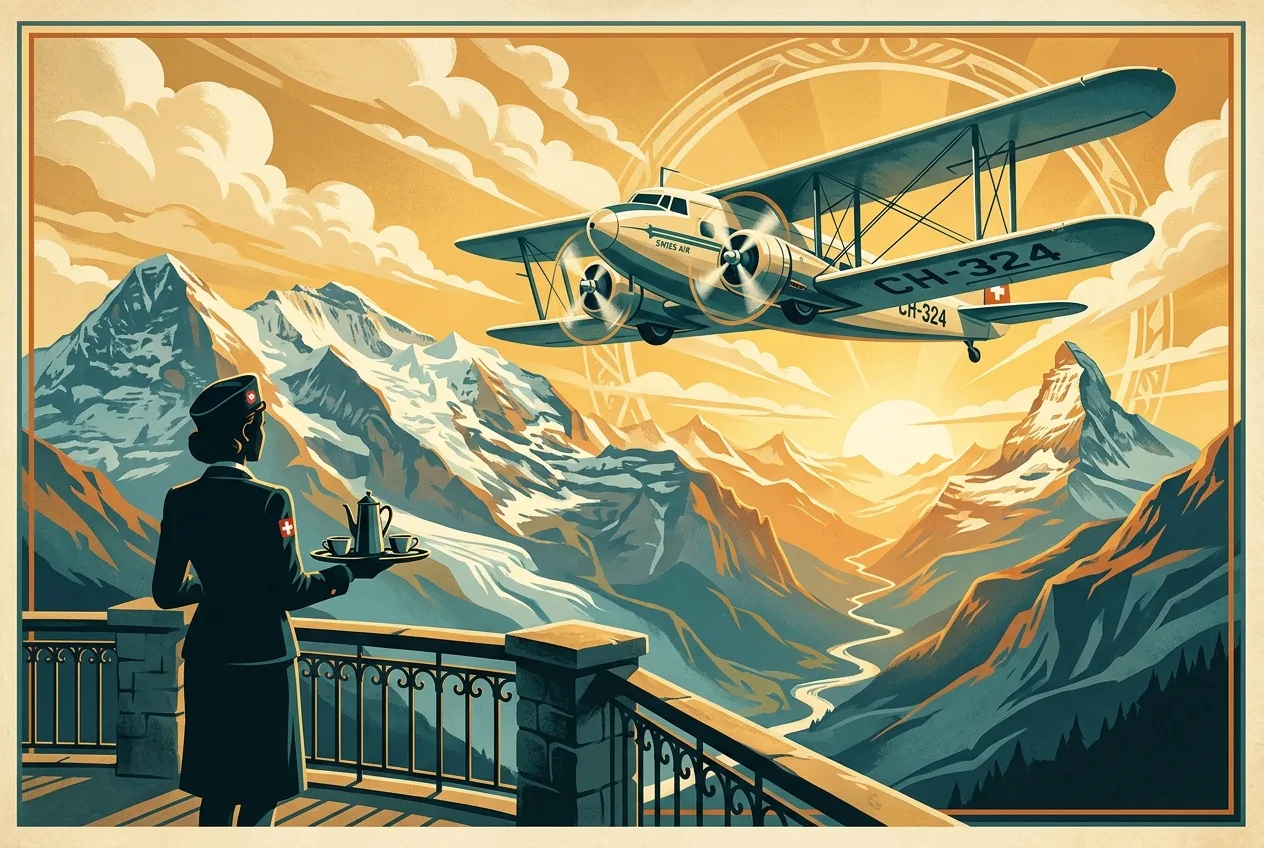
Zurich, May 1934. At Dübendorf airfield, a young Swiss woman in a neat uniform stands before an aircraft built largely from wood and fabric: the Curtiss Condor of the young Swissair. And when Nelly Diener steps onto the gangway that day, she makes history. She becomes Europe's first flight attendant, then known as an «Air Hostess».
A first above the clouds
Flying in the 1930s was an adventure for the bold: loud, shaky and far from ordinary. Swissair wanted to ease its passengers' fears and, looking to America, became the first European airline to bring a hostess on board. In the narrow cabin, Nelly Diener served bouillon and sandwiches, reassured nervous first-time flyers, pointed out the view of the Alps and, before long, came to represent a whole new age of travel.
The Curtiss Condor: a flying parlour of wood
Her workplace was almost as striking as the role itself: the twin-engine Curtiss Condor carried around 15 passengers, came with upholstered armchairs, curtains at the windows and a structure largely made of wood. On the Zurich–Berlin route, Nelly Diener somehow turned that creaking cabin into a cosy living room above the clouds. The press soon hailed her as the «Angel of the Skies».
79 flights that helped define an era
Nelly Diener's career lasted only a few months, yet it changed everything. She completed 79 flights, replied to fan mail from half of Europe and showed that hospitality in the air could feel just as natural as it did on the ground. Then, on 27 July 1934, her aircraft crashed near Tuttlingen; Nelly Diener was only 22 years old. Her legacy, though, carried on. The profession she established in Europe is now part of every cabin.
The pioneer at the Swiss Museum of Transport
If you want to encounter Nelly Diener, head to the Swiss Museum of Transport in Lucerne. In the Aviation and Space Hall, and in historical retrospectives such as «Above the Clouds», this pioneer is given pride of place. Quite right too: she remains one of the great Swiss figures in aviation history, and her courage and warmth helped shape an entire century of flying.